
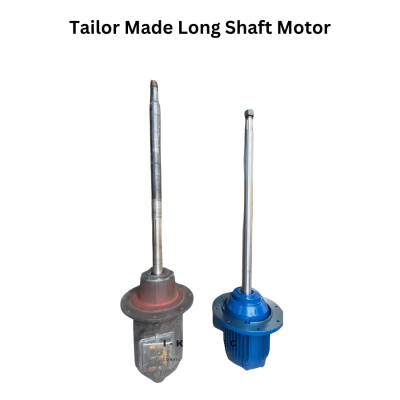
Application: Heat Treatment Furnace
Customer Requirements
LONG SHAFT OF 1 METER
SPECIAL BEARING HOUSING
DROP IN REPLACEMENT
HIGH TEMPERATURE APPLICATION
ONE TO ONE REPLACEMENT
24 Hour Application
Solution
For a customized long shaft motor used in a furnace operating at 950°C continuously (365 days, 24 hours), there are several key factors to consider in order to ensure the motor’s durability, efficiency, and performance. These include the material selection for the shaft, motor design, cooling methods, and insulation, among others.
- Motor Type
- High-temperature motor: You’ll need a motor designed to operate at extremely high temperatures. Motors are usually rated for temperatures up to 180-200°C, so a custom solution is necessary for 950°C.
- Synchronous or Asynchronous Motor: Typically, an asynchronous induction motor is used for high-torque, high-load applications. However, for specialized applications such as a furnace, a synchronous motor may be more suitable due to better efficiency under constant load.
- Shaft Material
The shaft is critical in maintaining structural integrity at high temperatures. Common materials include:
- Inconel 625 or Inconel 718: These are high-temperature alloys with excellent resistance to oxidation and corrosion at elevated temperatures.
- Stainless Steel (e.g., 316 or 304): Stainless steels with higher temperature ratings can also be used for the shaft material, but they might not handle 950°C as well as Inconel.
- Titanium Alloys: In some cases, titanium can be used for high heat resistance, though it is often not as durable at extremely high temperatures.
- Cooling Method
Given the furnace’s high operational temperature (950°C), active cooling will likely be required:
- Liquid cooling (water or oil): The motor might require a cooling system, such as a water or oil-cooled jacket around the motor, to prevent overheating.
- Forced air cooling: This can also be used in combination with other methods, but may not be sufficient at 950°C.
- Thermal insulation: Insulating the motor housing and shaft can minimize heat ingress and reduce the cooling load on the motor.
- Sealing and Bearings
- High-temperature bearings: These bearings should be designed to operate at 950°C. Ceramic bearings or bearings with high-temperature grease may be necessary to handle the temperature without failure.
- Seals: High-temperature seals (e.g., carbon or ceramic seals) are essential to prevent dust or contaminants from entering the motor, which is especially important in a furnace environment.
- Material Expansion
The shaft length (1 meter) will experience thermal expansion due to the high temperature, and the motor design must accommodate this. Precision in the fit of bearings and rotor alignment is necessary to prevent misalignment or mechanical stress from thermal expansion.
- Electrical Insulation
The windings and electrical components need to be made from high-temperature materials to prevent insulation breakdown:
- High-temperature varnishes: These protect the motor windings from the high temperatures.
- Specialized cables and connectors: Ensure that these components are rated for high temperatures to avoid electrical failures.
- Motor Duty Cycle
Continuous operation for 365 days, 24 hours, means the motor will be under load continuously, requiring a robust and highly durable motor design. A duty cycle of S1 (continuous) should be specified for the motor, meaning the motor is designed to run without overheating or needing rest.
- Motor Control
- VFD (Variable Frequency Drive): This would allow for controlled speed and torque management, which is important for efficient motor performance and extending its service life.
- Thermal protection and monitoring: Continuous monitoring of the motor’s temperature, vibration, and other parameters will be crucial to prevent overheating and ensure reliability.
Conclusion
In summary, you’ll need a motor specifically designed for high-temperature environments. The custom motor would likely involve the use of high-temperature alloys (such as Inconel), specialized bearings and seals, active cooling systems, and high-temperature insulation. Given the continuous nature of the operation, durability and thermal management are critical to avoid failure. Working with a specialized motor manufacturer with experience in high-temperature applications would be key to ensuring the motor meets these rigorous requirements.